Hi all, and welcome back to Signature Commander! This week, I’m going to try to build a budget version of my Vial Smasher the Fierce / Sakashima of a Thousand Faces deck. The goal is to maintain the basic function of the deck while keeping it under a tight $100 budget.
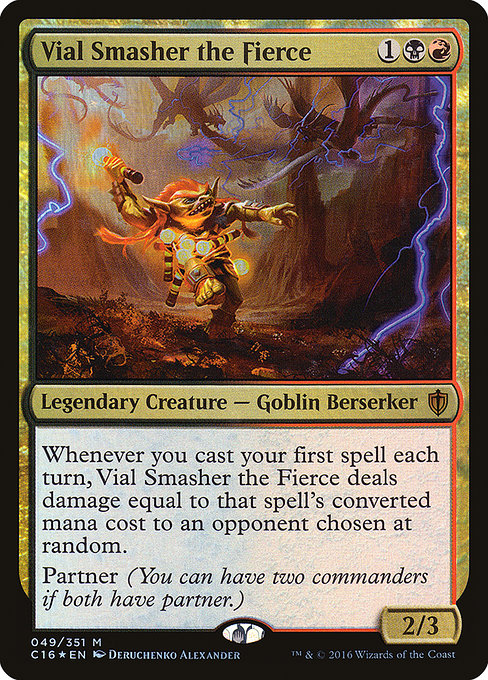

The low budget goal is a particular challenge for this deck because its commanders together cost over thirty dollars! The original mana base is pretty aggressive, meaning that the deck’s speed may take a hit, but I think I’ve crammed enough powerful cards into the remainder of the budget to keep it strong and fun.
In this article, I’ll focus on the low-budget cards that I swapped into the deck. If you’d like to check out the original decklist for context, go here first, then come back and find out what I changed to make it less expensive.
Finally, if you’d rather view this decklist without commentary, head over to Moxfield. Then come back here to let me know your thoughts below!
Strategy
To recap, the deck’s goal is to play Vial Smasher early and then clone it or otherwise copy its burn ability as many times as possible. Then, I can cast big haymakers that have a major impact on the board, all while burning out my opponents.
The deck leans towards goodstuff, since Vial Smasher’s ability serves as a win-con even while you’re using your mana on generally-powerful effects like efficient removal and card draw. While the $100 budget immediately excludes certain cards (hello, Reserved List!), there are still plenty of strong effects available to the deck on a dime.
New Cards
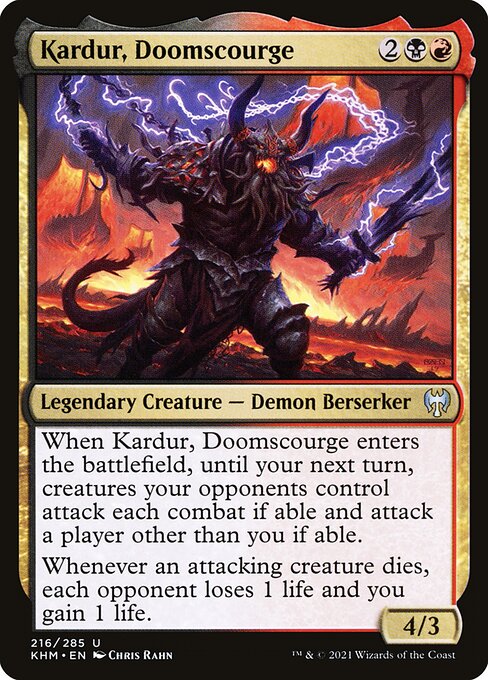
Disrupt Decorum, Kardur Doomscourge, Maestros Confluence, Part the Waterveil
Cards replaced: Temporal Manipulation, Temporal Mastery, Temporal Trespass, Time Warp
In the non-budget build, extra turns allow Vial Smasher to deal a big chunk of damage while giving you a free pass to untap. Then, if you’re lucky, you can do it again. If not, you can spend the extra turn doing whatever else you would have done if you hadn’t spent all your mana taking an extra turn.
Goading all creatures your opponents control is kind of like taking an extra turn, in the sense that Vial Smasher’s biggest vulnerability is the fact that this deck doesn’t play lots of creatures to block with. If you goad your opponents’ creatures, however, you’re safe from combat damage, and your opponents will either deal a bunch of damage to each other, or start losing creatures. Either way, win-win.
Do note that this effect is much worse when you’ve only got one opponent left, unfortunately. On the plus side, Vial Smasher’s effect becomes way stronger once the game’s a 1v1.
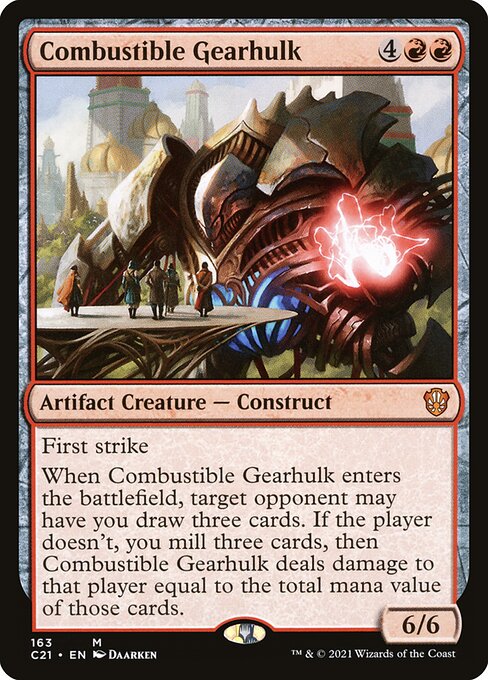
Combustible Gearhulk, Fevered Suspicion, Torrential Gearhulk
Cards replaced: Brass’s Bounty, Jin-Gitaxias, Progress Tyrant, Treachery
These are some of my favorite budget haymakers. Both Gearhulks are great blockers, and they work really well in a deck that’s already packing lots of clones. Fevered Suspicion is pricey in terms of mana, but it will trigger Vial Smasher for a huge burn twice.
Torbran, Thane of Red Fell replaces Strionic Resonator
The price difference between these two isn’t large, but I had to pinch pennies to hit the budget goal. Torbran tends to be better if you’re casting small spells on your opponents’ turns, while the Resonator tends to be better if you’re casting large spells on your turn.
Basilisk Collar replaces Shadowspear
Each of these equipment cards grants Vial Smasher lifelink for a total of three mana, and the swap is a huge cost savings. Losing trample and gaining deathtouch doesn’t make much difference, since Vial Smasher won’t attack often anyway. That being said, Shadowspear’s ability to strip hexproof and indestructible from your opponents’ creatures can be invaluable in certain situations, so it’s not a straight side-grade.

Counterspell, Foil, Misdirection, Siren Stormtamer, Sublime Epiphany, Supreme Will
Cards replaced: An Offer You Can’t Refuse, Arcane Denial, Deflecting Swat, Fierce Guardianship, Lightning Greaves, Malakir Rebirth
Foil and Misdirection are definitely much worse than Fierce Guardianship and Deflecting Swat, but they’ll do in a pinch. I chose Supreme Will as one of the additions to the counterspell suite since it doubles as card selection, and Sublime Epiphany is one of my absolute favorite cards in any deck that wants to copy creatures.
Kessig Flamebreather replaces Electrostatic Field
This is another minor penny-pinching swap. These two are essentially the same card.

Machine God’s Effigy replaces Phantasmal Image
This swap adds a little ramp to the deck while enabling a bit of cost savings. It’s kind of neat that Machine God’s Effigy protects itself by removing the creature type, as opposed to Phantasmal Image, which is even more vulnerable than the average creature.
Mana Geyser replaces Dockside Extortionist
This swap is a significant downgrade, especially considering the deck has access to clone effects, but there’s no way Dockside Extortionist can fit into a budget build. Still, Mana Geyser isn’t exactly weak.
Cards replaced: Deadly Rollick, Volcanic Offering
Murderous Cut is still nearly free, compared to Deadly Rollick, and Terminate is a great removal spell, if not as impactful as Volcanic Offering.
Archaeomancer, Dusk Legion Zealot, Read the Bones, Sign in Blood, Succumb to Temptation, Thirst for Discovery, Thrill of Possibility, Tormenting Voice
Cards Replaced: Dauthi Voidwalker, Demonic Tutor, Echo of Eons, Expressive Iteration, Jace, Vryn’s Prodigy, Ledger Shredder, Search for Azcanta, Time Spiral, Wheel of Fortune
The loss of three wheels is probably the single biggest impact of the budget on this deck’s functionality. Where possible, I tried to use instants to fill in some of the card advantage gaps, since Vial Smasher wants to cast things on its opponents’ turns to get more triggers. Windfall didn’t quite come in under budget, since it costs $4+, but it’s a good cheap addition if you’ve got some flexibility.
Bad River, Choked Estuary, Crumbling Necropolis, Darkwater Catacombs, Evolving Wilds, Exotic Orchard, Foreboding Ruins, Frostboil Snarl, Grixis Panorama, Island (x2), Maestros Theater, Mountain (x4), Myriad Landscape, Rocky Tar Pit, Shadowblood Ridge, Smoldering Marsh, Sunken Hollow, Swamp (x3), Tainted Isle, Tainted Peak, Temple of Deceit, Temple of Epiphany, Temple of Malice, Terramorphic Expanse
Cards replaced: Arid Mesa, Blightstep Pathway, Blood Crypt, Bloodstained Mire, Clearwater Pathway, Dragonskull Summit, Drowned Catacomb, Flooded Strand, Glasspool Mimic, Haunted Ridge, Luxury Suite, Marsh Flats, Misty Rainforest, Morphic Pool, Otawara, Soaring City, Polluted Delta, Riverglide Pathway, Scalding Tarn, Sea Gate Restoration, Shipwreck Marsh, Steam Vents, Stormcarved Coast, Training Center, Underground River, Verdant Catacombs, Watery Grave, Wooded Foothills, Xander’s Lounge, Wound Reflection
These swaps add a whopping 11 taplands to the deck, compared to almost zero in the original list. That’s not exactly a surprising number of taplands for a budget build that really wants to hit its colors. Hopefully, you have access to a few of the more expensive lands, but if not, this land base should still serve you well. I prioritized fetchlands in this list since the budget build of the deck still has some very strong Delve cards to fuel.
The odd card out here is Wound Reflection, which got replaced by a basic land. Unfortunately the budget just doesn’t have room for additional nonland cards, and this version of the deck has a bit of a higher average mana value.
Conclusion
During this process, I fell in love with a handful of cards I hadn’t even considered while building the original version of this deck. I am absolutely eager to try subbing in some of the goad cards if I bring this deck to tables that don’t like extra turns.
How do you like my budget build of Vial Smasher / Sakashima? Do you think I’ve missed some important cards that fit within the $100 limit? Let me know in the comments below!
If you enjoyed this article, please be sure to hit the like button, then follow my blog or add it to your RSS feed app of choice so you won’t miss out on all my future content!
Thanks for reading!
 Whatever i feel like
Leave a comment