Welcome to Signature Commander, the article series where I discuss the Commander decks I love to play! In this article, I’ll show off my Grist, the Hunger Tide deck, which strives to play as many creatures as possible in order to maximize the impact of Grist’s ultimate ability.
To view the decklist without commentary, head over to Moxfield. Then come back here to let me know your thoughts below!
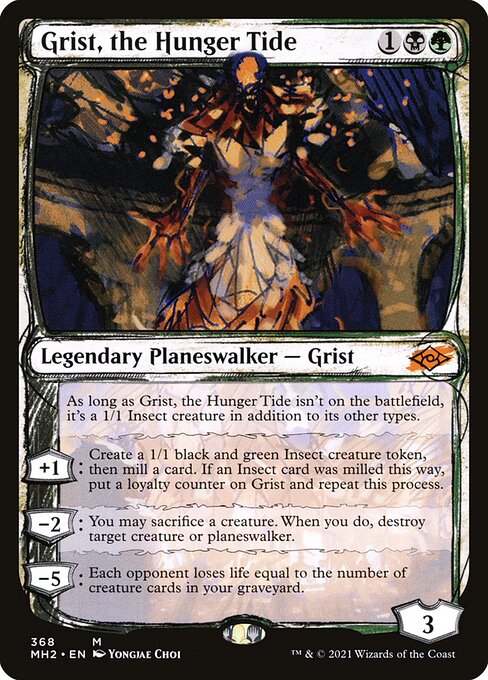
Grist has a couple of strengths that make her viable as a Commander despite the vulnerability inherent in the Planeswalker type:
- At just three mana, she’s easy to get onto the battlefield before other players start generating attackers.
- She makes creature tokens while ticking up, which increases her durability on multiple fronts.
- Under the right circumstances, she can threaten to use her ultimate ability after just one activation.
- Her ultimate ability hurts everyone at the table, not just a single target opponent.
Grist’s deck is built to put lots of cards in her graveyard. As a result, she’s vulnerable to graveyard hate. In my opinion, though, weaknesses are part of the fun. I consider it a fair tradeoff for the fact that Grist can occasionally come out of nowhere to deal a shocking amount of damage.
Strategy
The basic strategy is easy to understand–get as many creatures into the graveyard as possible, then win by using Grist’s ultimate to deal a bunch of damage. While Grist has a more achievable ultimate than most Planeswalkers due to its low cost and her ability to tick up quickly, she’s still vulnerable to combat damage and other forms of removal. As a result, this deck includes a couple of other ways to pull out a win.
The deck’s structure is a bit loose, and many cards are meant to fill multiple roles. Here are the rules that I followed while building the deck:
- At least one-third of the non-land cards should cost two mana or less, so that I can start building a board before casting Grist on turn three.
- At least one-third of the non-land cards should be Insects, in order to get more value out of Grist’s +1 ability.
- At least one-third of the non-land cards in the deck should have the ability to mill cards into my graveyard.
- Every card that can be a creature should be a creature. This is intended to maximize the value of Grist’s ultimate ability, and has some other incidental benefits.
This is the high-level structure of the deck (in terms of each card’s primary purpose):
- 36 lands
- 13 ramp cards
- 9 card advantage spells
- 12 removal spells
- 21 self-mill cards and Insects
- 8 win conditions
This deck tends to generate quite a few tokens and a fair bit of ramp. It wants to win with some combination of pumping all its tokens and swinging, sacrificing them for value, or dealing damage with Grist’s ultimate ability.
Decklist
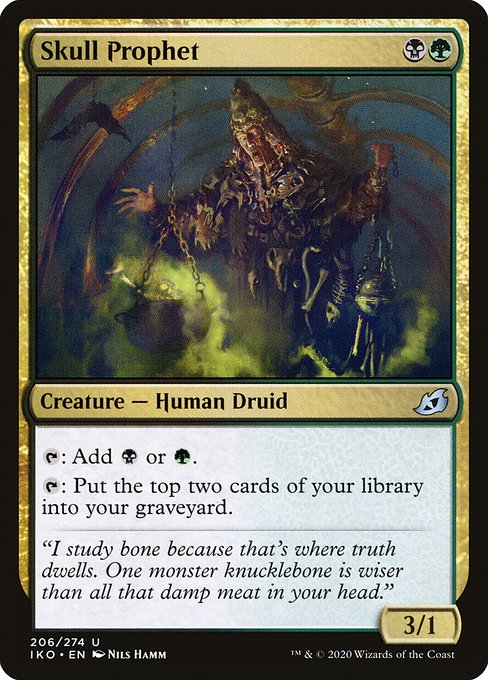
On turns where I don’t need its ramp, Skull Prophet can mill cards into my graveyard. That’s huge.
Birds of Paradise, Bloom Tender, Deathrite Shaman, Joraga Treespeaker, Sakura-Tribe Elder, Wood Elves
The above cards were chosen for their efficiency. Sakura-Tribe Elder and Wood Elves are particularly good in a creatures-only deck because they don’t have to risk removal to be useful.
This deck likes sacrificing creatures, so Viridian Emissary makes the cut.
While Duskwatch Recruiter doesn’t always function as ramp, this deck doesn’t always need ramp. I’ve included this card because the deck does need mana sinks, and Duskwatch Recruiter’s front face is a phenomenal one.
Nantuko Elder’s rate for ramp isn’t bad, and it’s a card I’d love to mill with Grist.
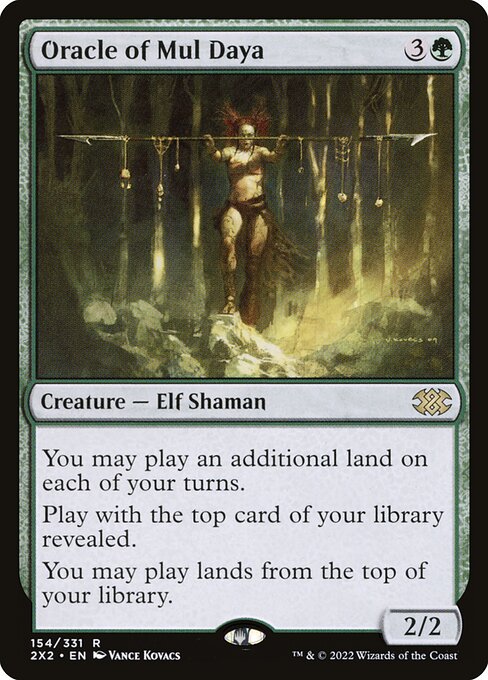
This card performs triple duty in my deck. With the Oracle, I can remove lands from the top of my library, which empowers Hermit Druid, Undercity Informer, and Grist herself. Being able to see whether the top card is an Insect or not is extremely helpful on its own. In addition to functioning as ramp when I have extra lands in hand, Oracle of Mul Daya combines with cards like Ramunap Excavator to loop fetchlands when I haven’t been able to draw extra lands.
This hydra is one of my favorite cards, period, and in this deck it can help me find either half of the Urborg / Cabal Coffers combo. The deck has a couple of other utility lands as well, which makes the hydra a great include. Finally, Ulvenwald Hydra is a strong beater and a strong blocker.
World Shaper mills my deck and can put quite a lot of lands onto the battlefield at once. Since Grist’s -2 ability is a sacrifice outlet, I don’t have to wait for World Shaper to die naturally in order to use its ramp ability.
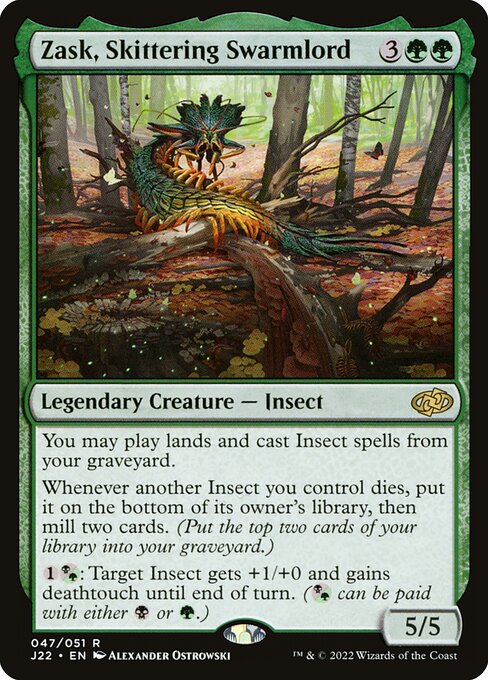
Zask, Skittering Swarmlord and Ramunap Excavator
These cards are similar in that they let me pull lands out of my graveyard. Zask also allows me to do the same with Insects, and serves as an additional source of self-mill. I’m not sure whether its activated ability will do much work in my deck, but it’s nice to have in case I need a good blocker.
Graveshifter, Body Launderer and Undead Butler
Each of these cards allows me to pull one of my strong creatures out of my graveyard after they get milled or killed. In addition, Graveshifter is an Insect for the purposes of Grist’s +1 ability, and the other two come with their own self-mill abilities.
Like the above, Meren allows me to pull cards from my graveyard into my hand. The fact that she can do it repeatedly, as well as straight reanimate creatures under the right circumstances, is quite strong.
God-Eternal Bontu and Izoni, Thousand-Eyed
Each of these creatures can turn stray Insect tokens into real cards. The fact that Izoni produces her own is phenomenal.
Realmwalker is a great “Insect” but arguably a bit of a nonbo with my commander. If there’s an Insect on top of my library, I usually want to mill it away with Grist’s +1 ability. If I cast it instead, then I risk removing power from Grist’s +1. I think I need Realmwalker in order to hit the right number of Insects in the deck, but it’s not my favorite include.
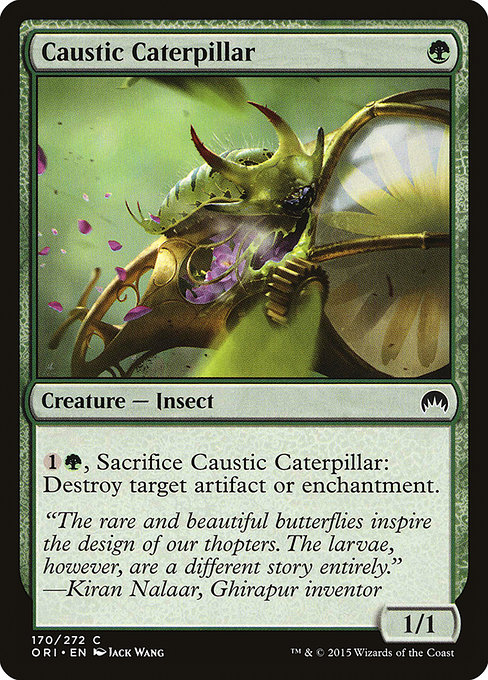
Caustic Caterpillar, Haywire Mite, and Caustic Wasps
Each of these is an Insect that can remove artifacts (and in the case of the first two, enchantments). The first two are certainly easier to use, though.
Demon’s Disciple and Plaguecrafter
My first version of this deck used more of these kinds of effects as as sort of efficient, reusable creature-based mass removal. I removed a few to make room for more Insects, but these two stayed.
Murderous Rider, Canoptek Tomb Sentinel, Kraul Harpooner
Each of these cards serves as single-target removal while looking like creatures in the graveyard. The latter two are Insects, as a bonus. This deck really wishes Murderous Rider could die and stay in the graveyard.
This is an easy and powerful include since the deck plays almost no artifacts and enchantments.
These are wraths on bodies, which means they can be recurred occasionally. Massacre Wurm’s ability to deal lots of damage is especially helpful.
This card is wonky and old, but it’s repeatable land removal on an Insect, which can be powerful under the right circumstances. The fact that it lets me sacrifice creatures that want to die is just gravy.
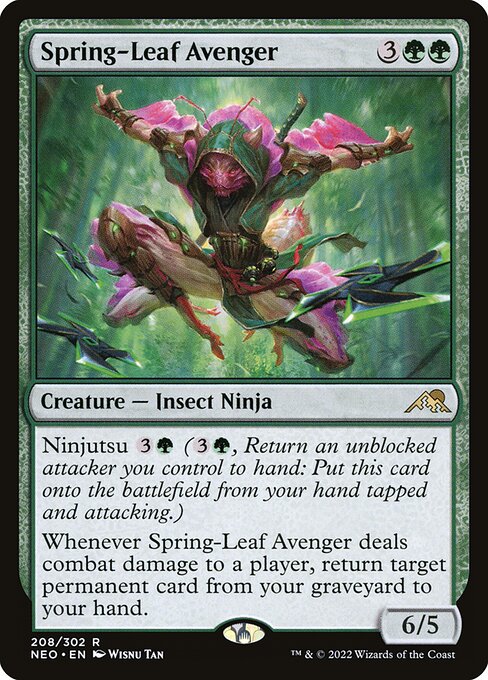
Blightbeetle, Circuit Mender, Kazandu Nectarpot, Spring-Leaf Avenger, Virus Beetle, Masked Vandal and Canoptek Scarab Swarm
Each of these provides incidental value on an Insect. Spring-Leaf Avenger can occasionally provide repeatable card advantage, which is very helpful. Canoptek Scarab Swarm can remove an entire graveyard and produce quite a lot of Insect tokens all at once.
Scute Swarm and Mazirek, Kraul Death Priest
Like the above, these cards make the cut because they’re Insects, but the value they provide is a cut above the first group. Each of these cards can be nearly a win condition on its own.
Dogged Detective, Golgari Grave-Troll, Golgari Thug, Kagha, Shadow Archdruid, Stinkweed Imp, and Stitcher’s Supplier
Each of these provides cheap self-mill and in some cases additional incidental value.
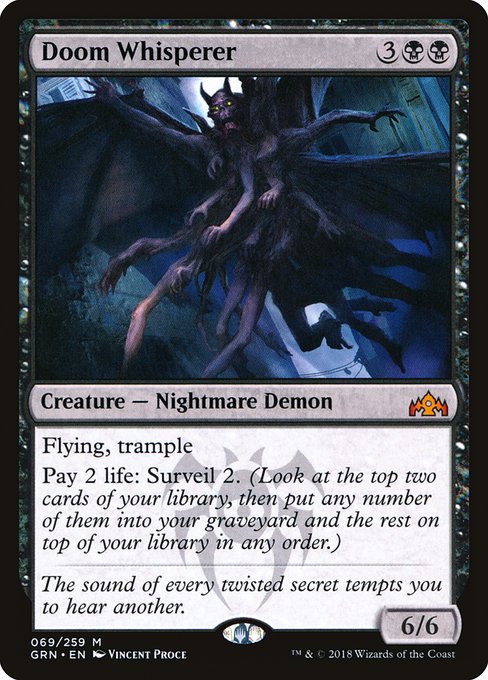
Doom Whisperer, Hermit Druid, Undercity Informer, Old Stickfingers, and Maskwood Nexus
These cards are some of the most important engines in the deck. The first two are the most powerful, and can put enough creatures into the graveyard for Grist’s ultimate to win the game on their own. Doom Whisperer can do it the turn it enters the battlefield. Hermit Druid and Undercity Informer both encourage the deck to use its land slots for utility, which I’ll cover later. Old Stickfingers sticks around as a beater.
Maskwood Nexus is the least immediately powerful card in this group, because it requires you to continue using Grist’s +1 ability in order to fill the graveyard for her ultimate. It’s worth noting that Maskwood Nexus also powers up both Realmwalker and Zask in terms of generating card advantage.
This deck really wants a repeatable, free sacrifice outlet, and Dross Hopper happens to be the cheapest Insect that can fill that role.
Dreadhound, Syr Konrad, the Grim, and Zulaport Cutthroat
Each of these can generate a win when paired with a sac outlet. The first two are especially favorable because they mill cards on their own and drain life when my creatures get milled by any other source as well.
This card is not as strong as I’d like, since it can only take out one player at a time. It’s nice to have nearly a second version of Grist’s ultimate in the 99, though.
This win condition takes advantage of the fact that my deck tends to generate a lot of otherwise-weak tokens. It’s nice that it both sticks around and can turn my extra lands into beaters, too.
This is just a big beater that happens to generate card advantage if it dies, and is also an Insect. This is a card I would cut if I had some better options.
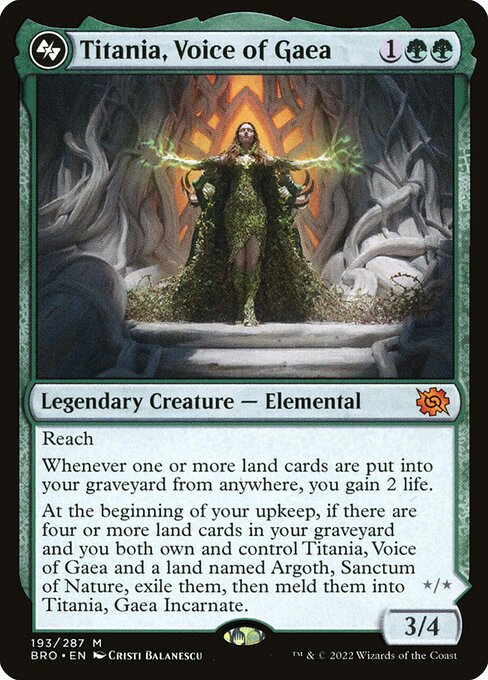
I wanted to include her first and foremost because she generates some incidental lifegain as I mill lands. The fact that she can turn into a win condition without too much extra effort is quite nice.
The final nonland card in this deck is a tutor on a creature. I don’t love including tutors in my decks, but this deck really depends on finding its card advantage spells and its win conditions, so I included this thematically-appropriate one.
Tangled Florahedron, Blackbloom Rogue, Kazandu Mammoth, Dryad Arbor
If I draw any of these cards, they will usually get played as lands. It’s nice that Tangled Florahedron happens to function as a Rampant Growth if I’ve got extra lands, but the real reason I’ve included these cards is to serve as creatures in the graveyard to fuel Grist’s ultimate.
Agadeem’s Awakening, Bala Ged Recovery, Hagra Mauling
These are the only cards in the deck that aren’t either a creature or land on their front face. Like the above group, they will usually function as lands when drawn. I’ve included them because Undercity Informer wants the deck to have as few cards as possible that are lands on their front face.
While I included this card primarily to meld with Titania, it’s really nice that it also happens to have a mana sink ability that mills me.
This card is essentially a ramp spell if it happens to get milled.
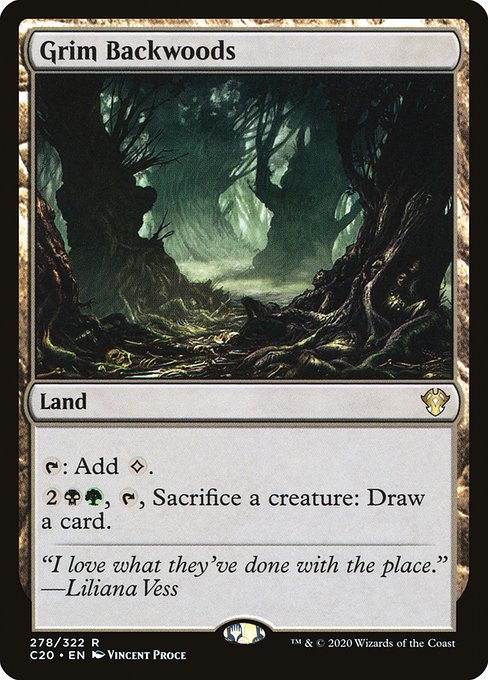
Have I mentioned this deck really, really wants mana sinks in some situations? Grim Backwoods is a great way to use extra mana and tokens all at once.
The rest of the lands in the deck require little explanation. Currently, I’ve got nine basics, which is probably still a bit high given that Hermit Druid happens to be one of my best cards. I don’t want to fill the deck with too many more tapped lands or colorless lands, but there are probably a few more non-basic options I will consider in the future, like Boseiju, Who Endures.
Shortcomings
In playtesting, this deck tends to end up with a lot of extra mana, a lot of extra tokens, or both, with no way to turn them into a win.
I’ve opted for an all-creature deck, which removes my ability to use certain artifacts and enchantments that could be strong. That being said, each non-creature card I add to the deck risks diluting the volume of creatures in my graveyard, which could weaken Grist’s ultimate.
In order to improve my version of the deck, I’ll be looking out for more Insect cards that function as sacrifice outlets, card advantage, self-mill, or win conditions–and preferably some combination of more than one of those. Many of the best Insects have been printed in just the past year or two, though, so I’m optimistic.
Conclusion
I love this deck because it’s just weird. In a lot of cases, it’s fighting on axes that other decks don’t, which makes it unique to pilot and occasionally difficult to counter. In addition, Grist’s abilities open up the opportunity for some really challenging and fun deckbuilding choices.
If you enjoyed this article, please be sure to like it and leave your comments below. Then follow my blog or add it to your RSS feed app of choice so you won’t miss out on all my future content!
Thanks for reading!
 Whatever i feel like
Leave a comment